

The Pig That Almost Disappeared
Introduction to the Cinta Senese heritage breed.

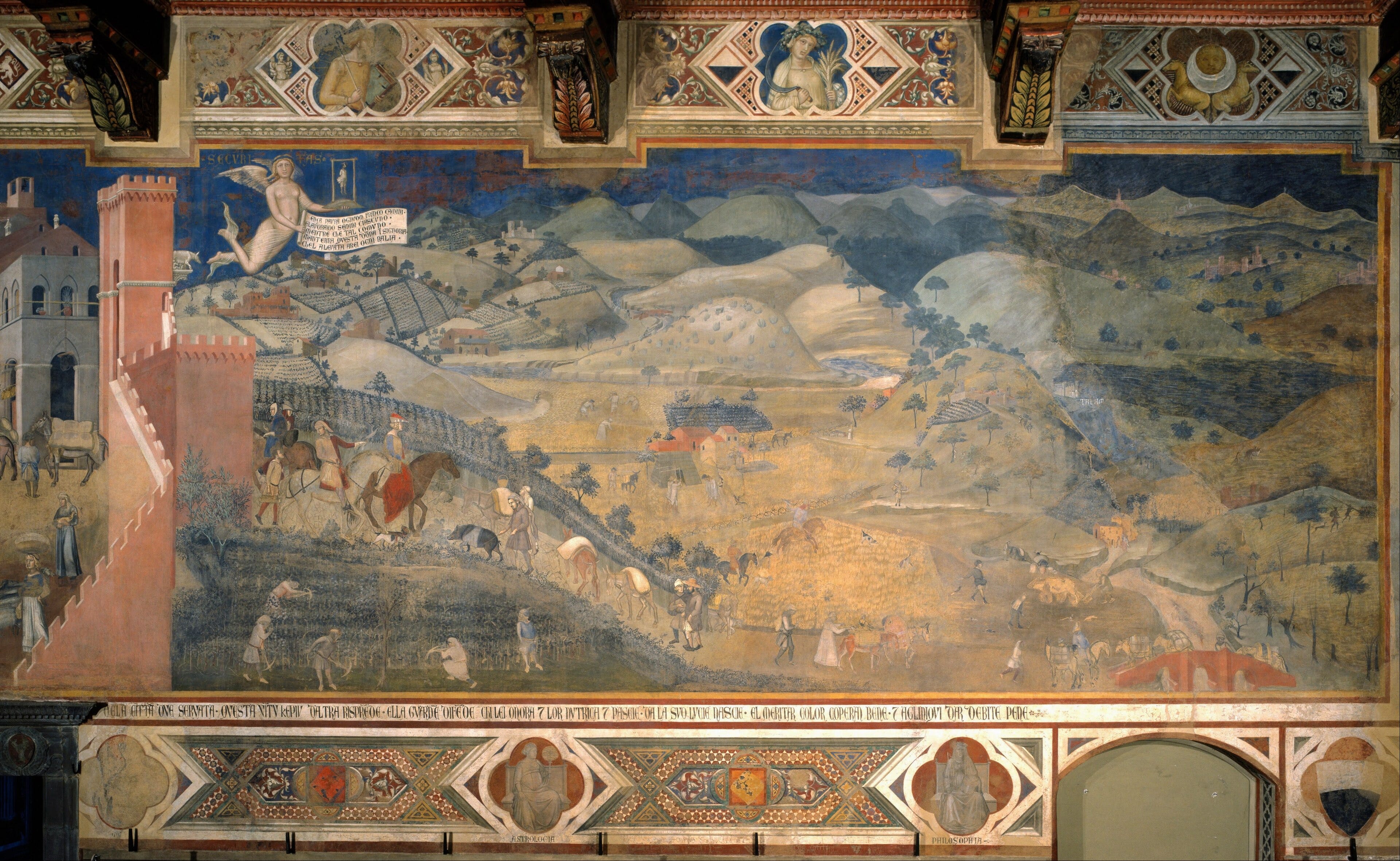
The Palazzo Pubblico, located in the Piazza del Campo in Siena, is the city’s historic palace and center of civic activity since its construction began in 1297. Inside, Ambrogio Lorenzetti’s fresco cycle The Allegory and Effects of Good and Bad Government (1338-39) features detailed images important to the ruling elites of Siena. For our purposes, there’s one unique element in the cycle’s countryside panel — Effects of Good Government in the Countryside — a particularly handsome pig. Among the farmers, harvests, and pack animals going about the business of a well-run countryside, the pig has a dark coat, with a white band said to mark its front legs and shoulders — a belt, in effect. Almost seven hundred years later, that same belt is still how you’d recognize a Cinta Senese today.
Cinta means belt. Senese means “of Siena.” Together, the name is almost a description rather than a name — a black pig from Siena’s countryside, marked by a white stripe across its front half. It’s been bred in this region for centuries, indigenous in the truest sense: not imported, not engineered, just shaped slowly by this particular stretch of Tuscan land.
Too Slow for the Modern Farm
By the 1980s and 90s, the Cinta Senese had nearly vanished.
The reason is almost entirely about time. A Cinta Senese takes about two years to reach maturity. A commercial breed like the Large White does it in eight or nine months. In an industry built around speed and volume, a pig that takes more than twice as long to raise — and that runs naturally fat besides — simply didn’t fit. Through most of the 20th century, agriculture rewarded the fast and lean. The Cinta Senese is neither. It nearly disappeared because it refused to be efficient.
After World War II, Danish and English breeds were introduced to Italy and the slower breeding Cinta Senese, along with other native Italian pigs, began to disappear quickly. In 1927, there were 27 heirloom breeds in Italy and today we are lucky to find 6 — the Cinta Senese among them.
What saved it, in the end, is the same trait that almost killed it: that fat. Raised right, it isn’t a flaw — it’s where the flavor lives.
Raised the Old Way, By Law
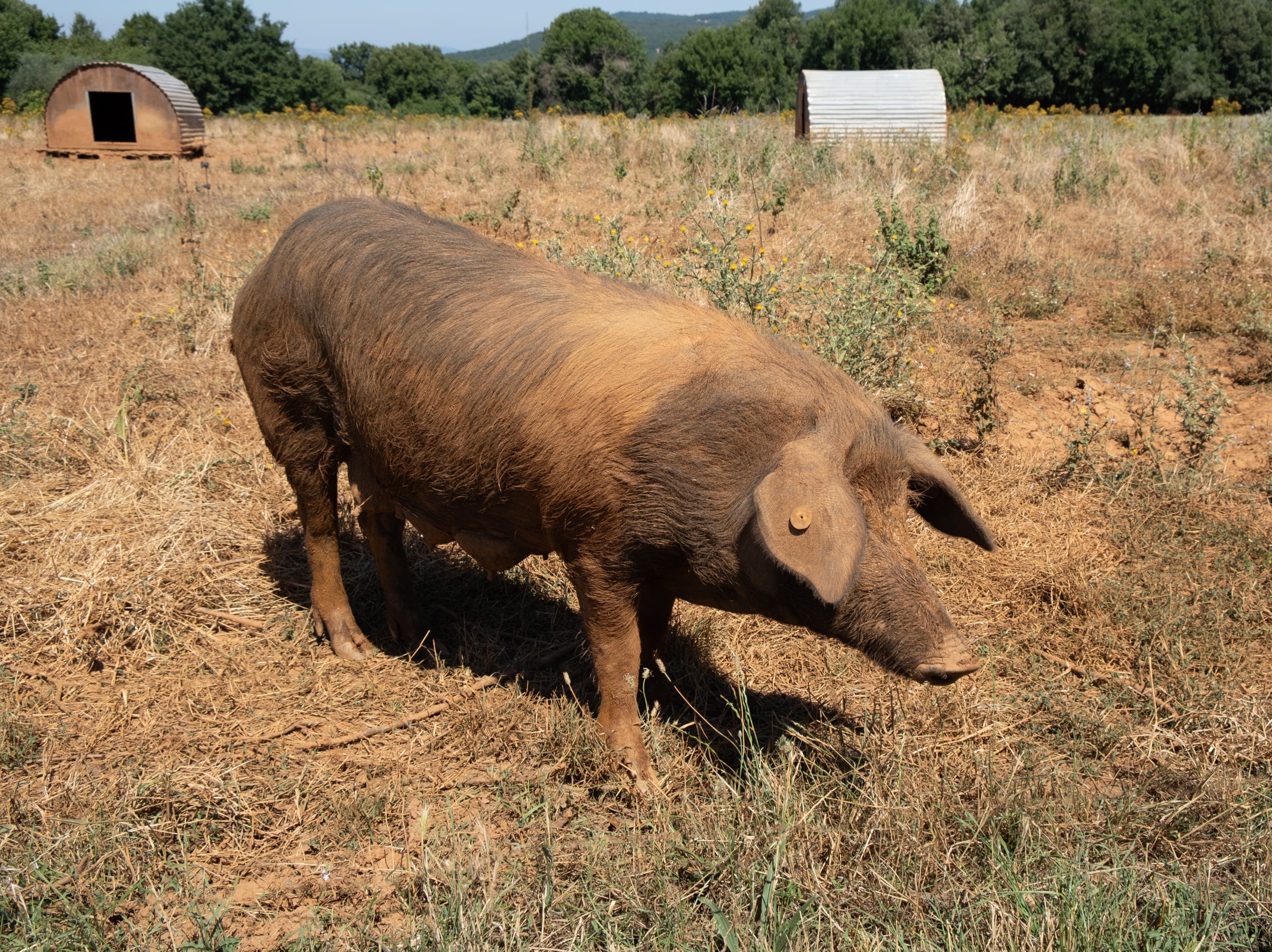
Today a consortium oversees how Cinta Senese can be raised and still carry the name, and the rules read like a description of how pigs lived before anyone thought to industrialize them. They must be free-range, with access to open pasture and wooded land for foraging. Supplemental feed is capped at just 2% of the pig’s body weight per day — everything else, the pig has to find for itself: acorns from Mediterranean evergreen oak, wild mushrooms, truffles, whatever the forest floor offers up that season.
At the farms still raising them this way, the supplemental feed itself is often milled on-site — a blend of oats, barley, and favino, a black fava bean that supplies the protein component. The ratio shifts with the pig’s age: more bean and protein when they’re young and growing, more carbohydrate as they near the end of their life, fattening for the butcher.
It’s worth pausing on the mud, too, because the Cinta Senese’s relationship to it isn’t the stereotype people assume. Pigs don’t sweat, so wallowing is thermoregulation — a layer of mud that keeps them cool from the outside in, and incidentally keeps biting insects off their skin. It’s practical, not slovenly. And their long ears, which fall forward over their eyes, aren’t an aesthetic accident either — they’re built for pushing through underbrush while foraging, a kind of built-in blindfold for an animal that spends its life nose-down in the forest.
One Pig, One Family, One Year
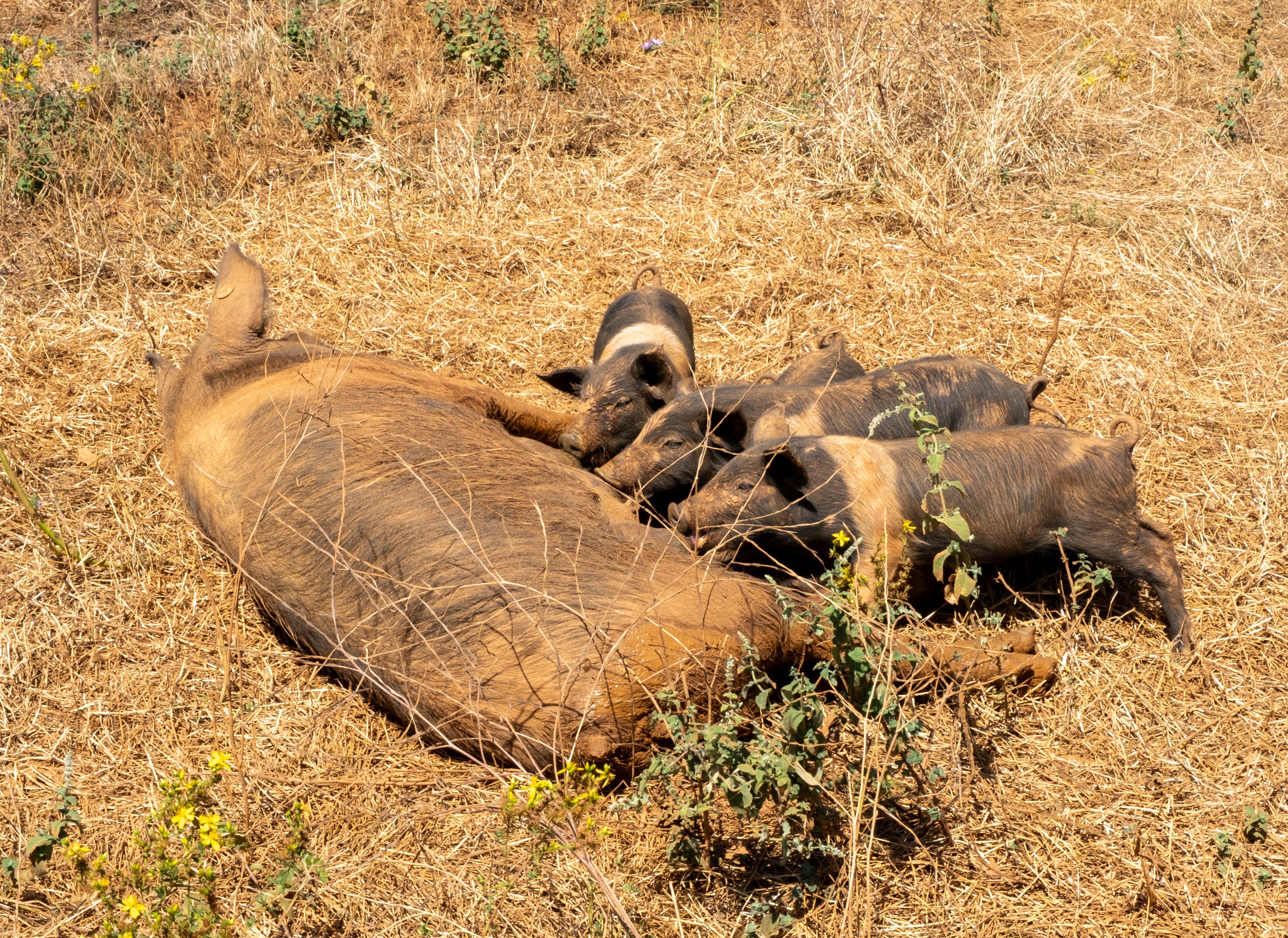
At Tenuta di Spannocchia, the Cinelli family runs a small, deliberate operation — around 70 pigs a year, all raised and processed organically, with the curing and aging done entirely on-site. Spannocchia’s version skips the modern shortcuts entirely: no nitrates. Just salt, pepper, air, and time. The pig itself only leaves the property for one day, for the actual butchering nearby; everything after that — the curing, the salting, the aging — happens back at the farm.
The logic behind it is older than refrigeration. Traditionally in Tuscany, one pig was meant to feed one family for an entire year, which meant the meat had to be processed in stages that aged at different speeds, so that something was always ready to eat. Buristo — a cooked blood sausage — is ready within days and lasts only a couple of months. Salami takes up to three months to age. Capocollo, around six. Prosciutto is the patient one: twenty-four months, the better part of two years, before it’s ready.
Eaten in that order — fresh, then cooked, then cured — a single pig could carry a family from one season into the next.
On the Plate
I first understood what all of this adds up to in a small restaurant inside Siena’s city walls, where Chef Francesca showed me how Sienese cooks turn buristo into something else entirely: Pici al Buristo, a dish built on the same blood sausage Spannocchia ages for just a couple of months before it has to be eaten. It’s a fitting way to close the loop — from a fresco wall in the Palazzo Pubblico, to a forest floor thick with acorns, to a curing room that smells like salt and garlic, to a plate of pici in a kitchen that’s been making this dish for generations. 700 years of history brought to life by a resurrected heritage breed and dedication to slow, meaningful processes that are still feeding us to this day. Watch for a follow-on post that dives deep into how DOP prosciutto is made — coming soon.